
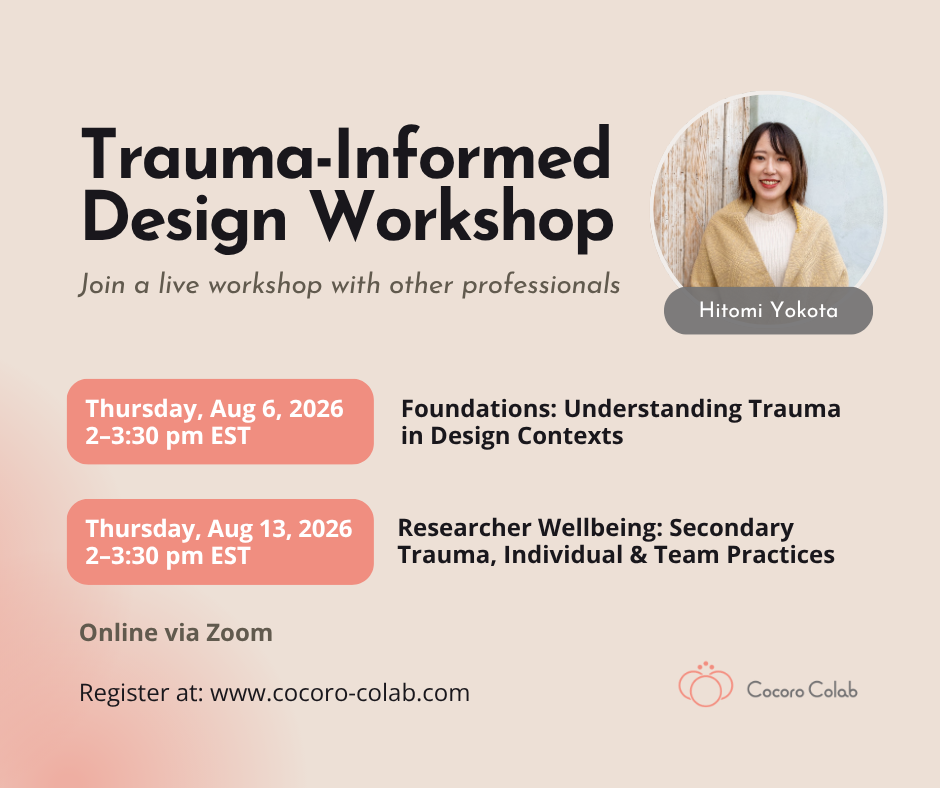
Trauma-Informed Design Workshop for Designers, Researchers & Changemakers
An online workshop series that helps you integrate trauma-informed practice into your design work to improve research quality, participant trust, and ethical integrity.
Module 1. Foundations: Understanding Trauma in Design Contexts (registration closed)
Thursday, August 6, 2026, 2-3:30 pm EST
Module 3. Researcher Wellbeing: Secondary Trauma, Individual and Team Practices (registration closed)
Thursday, August 13, 2026 · 2–3:30 pm EST
Format: Live online, interactive, 90 minutes, in a small cohort
Who it’s for: Designers, design researchers, user researchers, and community engagement professionals.
Designing with care in emotionally complex contexts
Designers and researchers are increasingly working in spaces shaped by vulnerability, loss, systemic harm, and emotional load. Yet most design training focuses on methods and outcomes, not on how trauma, stress, and nervous system responses shape research, participation, and decision-making.
This workshop series introduces trauma-informed design as a practical, ethical, and sustainable approach to design and research practice.
Who this workshop is for
This workshop is designed for professionals who:
Conduct research, co-design, or user experience work
Lead programs with high participant exposure or emotional complexity
Want to integrate ethical, reflective practices into their work
Seek to sustain presence, resilience, and grounded professional judgement
The workshop includes:
A small cohort to enable meaningful discussions and practices
A combination of didactic and interactive, practical activities
Take-home resources and worksheets
Module descriptions
Module 1 — Foundations: Understanding Trauma in Design Contexts
This is a foundational module to understand trauma and trauma-informed design.
Goal:
Build foundational literacy on trauma, stress responses, and how they appear in research or co-design settings.
By the end of the workshop, participants will:
Identify different types of trauma and how they may indirectly influence participants
Recognize cues of stress and nervous system activation without pathologizing
Map your own “silent load” in research or project work
Apply a trauma-informed lens in observation and decision-making
Participate in peer activities and discussions
Module 2 — Trauma-Informed Design Research Application
This module adds on to the foundations of Module 1. Taking Module 1 before this module is recommended, but not mandatory.
Goal:
Learn practical methods for designing research that supports psychological safety, autonomy, and ethical engagement.
By the end of the workshop, participants will:
Design research protocols that incorporate trauma-informed principles.
Learn how to plan for psychological safety across the research lifecycle.
Apply trauma-informed language and micro-skills to support respectful and regulated participant engagement
Have completed exercises to review and update research materials.
Module 3 — Researcher Wellbeing: Secondary Trauma & Self-Regulation
This module adds on to the foundations of Module 1. Taking Module 1 before this module is recommended, but not mandatory.
Goal:
Build awareness of the emotional and ethical load in research and learn strategies to maintain your own wellbeing.
By the end of the workshop, participants will:
Identify how repeated exposure to distress impacts cognition, mood, and relationships
Recognize somatic signs of emotional overload
Apply individual and team-level self-regulation strategies
Use structured reflection tools to process emotional impact
Sustain ethical judgment and research quality over time
Registration
Registration closed for both Modules 1 and 3
One module:
Self-funded:$120
Organization-funded: $160
Reduced rates (limited availability - for those who have financial difficulty): $70-90
Two-module bundle (registration closed):
Self-funded: $220
Organization-funded: $290
Reduced rate: $160
About the Facilitator
Hitomi Yokota, Founder of Cocoro Colab, is a licensed psychotherapist and service designer with over a decade of experience bridging trauma-informed care with human-centred design. She founded Cocoro Colab to provide the education designers and researchers need to engage with sensitivity, care, and ethical awareness.
Credentials:
Registered Psychotherapist (CRPO)
Master’s in Interdisciplinary Design Strategy
Master’s in Clinical Mental Health Counselling
Specialized trauma-informed training (including EMDR, IFS, Somatic Experiencing, Somatic Embodiment, DBT).

Interested but not ready?
If you’d like to:
Receive updates on future modules
Access early registration
Get the Friend Discount
Join the Community newsletter!